27 March 2011

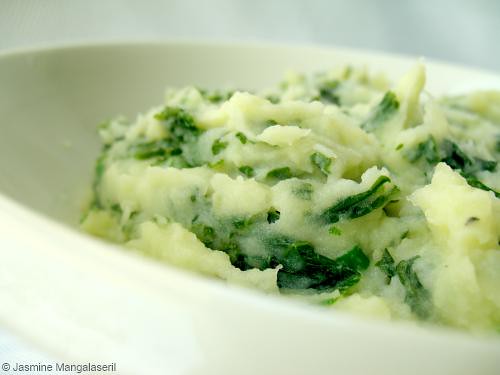
Colcannon

I love it when I find an incredibly easy and tasty dish. Don't get me wrong: for the most part I still love spending a couple of hours in my kitchen, carefully dosing out ingredients, slowly folding and rubbing and waiting for volatile oils to release and scent the air. The truth is I don't always have that sort of time to devote to feeding myself (sad, isn't it?). I'm normally on the lookout for something quick, delicious and slightly different from the same-old same-old, but one that can be completed in those fleeting moments between work, meetings, going out and sleep. From time to time I find a solution so elegant in its simplicity, I wonder why I didn't try it before. Colcannon is one of those foods. A traditional Irish dish, it's simply sauteed greens stirred into mashed potatoes. As someone who loves sauteed kale, cabbage and other deep leafy greens almost as much as I love creamy (and garlicky) mashed potatoes, this is pretty much a happy foodish marriage to my tastebuds and gullet. What makes it better (I think) is that it's pretty much a non-recipe recipe. Don't believe me? Here's proof:

  • Step one: Saute some kale (or green cabbage or other leafy green).

  • Step two: Mash some potatoes (preferably with milk/cream and butter).

  • Step three: Mix everything together.
Still don't believe me? Read the painstaingly recorded instructions which follow this bit of expository. To summarize:

  • Step one: Saute some kale (or green cabbage other leafy green).

  • Step two: Mash some potatoes (preferably with milk/cream and butter).

  • Step three: Mix everything together.
See? Colcannon Serves 4-6 Ingredients 250g (0.5lb) Kale leaves, chopped (one bunch) 1 shallot, thinly slivered 4 spring onions, green parts only, finely chopped butter, for sauteing and mashing 500g (1lb) Yukon gold potatoes (or any mashable potato) 125ml (0.5c) milk 1 clove garlic, smashed salt pepper Method: Fry the shallots in butter until golden. Add the kale and spring onion greens and a couple of tablespoons of water to the pan. Give it a stir and lid the pan and let the greens steam lightly--the green will be vibrant, but the veg won't be limp. Remove the lid and let the water evaporate, stirring occasionally. Season with salt and pepper. Set aside
Parboil potatoes in salted water. When they are about half-cooked, drain off 2/3-3/4 of the cooking water and retun to the hob, put the lid on and steam over low heat until an inserted knife blade or fork easily slips in and out of a potato. When the potatoes are about ready, heat the milk with the smashed garlic. Mash the potatoes to your liking, using the garlic-infused milk and butter. Stir in the cooked greens. Balance flavours to taste. Notes:

  • You can substiute cabbage (savoy or green) for the kale.

  • If you have bacon fat on hand, use that to saute the greens.


cheers!


jasmine


I'm a quill for hire!


20 March 2011

Corned Beef


It all started off innocently enough.

Visions of home made corned beef and cabbage along with the inevitable sandwiches and hash danced in my head, in the same way that sugar plums make their obligatory appearances at Christmas.

Recipes abound online and it all looked simple: let a beef brisket soak up a spiced brine for a week or two, boil it up and then eat.

Easy, right?

Wrong.

Well...not really wrong. Just not as easy as I thought it would be.

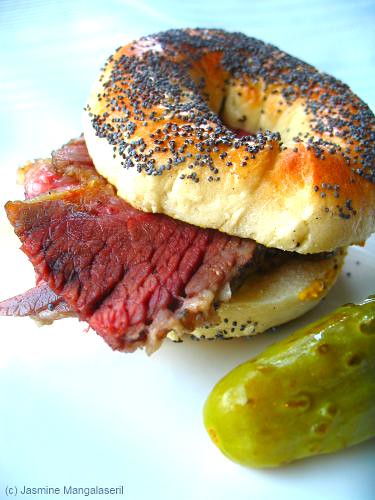
When little, the only corned beef I knew was canned: salty, fatty, PeptoBismol coloured with a particular pre-digested texture similar to Spam. The cool part was you had to open the can with a key. Later I discovered corned beef sandwiches made of sliced cured beef. Wow. The difference was akin to contrasting 1970s polyester to pure silk.

A couple of years ago I bought a "make your own corned beef" brisket--a plastic-encased brisket, swimming in a slightly viscous, but spiced brine. Snip the end and boil. It was okay at best, chemical at worst.

This year I decided to corn (or cure) my own brisket for St. Patick's Day. I looked at a number of recipes and for the most part it seemed doable. I was starting early enough in the month that a corned beef supper shouldn't have been an issue.

It was all good, except for what turned out to be an elusive ingredient: saltpetre.

Unfortunately my favourite haunts' can't get it in. Many pharmacies either don't carry it or have had it on back order for months. (As an aside: I was more than concerned when I had to educate one pharmacist about it. Yes, I'm pulling my prescriptions from there).

Saltpetre has been used as a curing agent since the Middle Ages to keep a lovely slice of charcuterie from turning into a petri dish of nasty bacteria. It's also primarily responsible for corned beef's and salami's characteristic pink colour.

Saltpetre is used in compounding and has been used to alleviate various conditions.

Saltpetre is a nitrate. Nitrates are, from what I've read, safe to eat, but they become unsafe when they turn into nitrites which can spur cancer-causing chemicals in animals.

Saltpetre is also an ingredient in black powder and some fertilisers

Saltpetre is a legal substance in Canada and you do not need special permits to buy it (for curing meat--not sure about fertilisers and other uses).

My butcher and I had a chat about this. He told me it's difficult to find around here as are substitutes such as InstaCure No. 1 (aka Prague Powder No. 1), Pink (curing) Salt and other curing salts such as Tender Quick is just as scarce in these parts. Hrmm...

I was willing to make a brown corned beef, but I'm tenacious (read: stubborn). Up popped Canada411 and I reached for my phone. Several calls later I found a bottle, tucked in the back of a cupboard at an almost out of the way drug store. Even the pharmacist who sold it to me didn't realise he had a bottle as he's shooed off several people emptyhanded over the past few months.

It's pretty obvious. The kitchen deities were on my side. Appropriate offerings will be made, in thanks. Thank goodness they like chocolate.

I looked at a few recipes and came up with my own, scaled down to a 1kg (2lb) brisket (thank you, my darling butcher for cutting a reasonably-sized piece for me)--unlike other recipes I've seen, I wanted something that would feed four people...not 10.

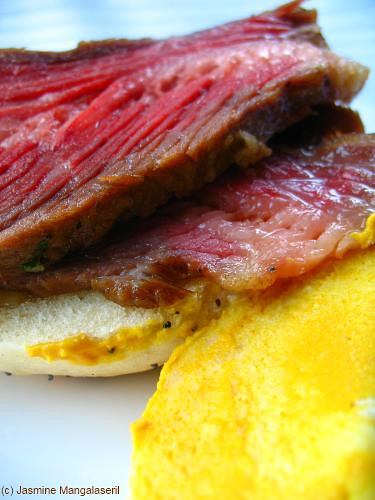
It mostly went to plan. A couple of minor SNAFUs occured: the container it was in didn't let me weigh the meat down, so I turned the brisket over daily to ensure both sides were brined. I was a little worried when I took it out of its poaching liquid--the outside browned a bit, but as I sliced it, its pink interior made me smile. And...of course... I carved with the grain, as opposed to against it.

Again, the kitchen deities smiled upon me. The brisket was tender and the spice combination was absoultely delicious. I'm quite happy with this attempt and I'll do it again--I'll get a bigger container and play with the spicing a bit. I may even see how long it's safe to brine the meat without using saltpetre (apart from freezing the meat in the brine)--there's nothing wrong with brown corned beef. Until then, here's the recipe I used.


Corned beef
Serves 4-6
Adapted from recipes by
Lobel, Alton Brown and about.com
Brining time: 2 weeks
Cooking time approximtely 3hrs

Ingredients

For the brine:
0.5tsp whole black peppercorn
0.5tsp mustard seed (black or yellow--I used black)
0.5tsp whole coriander seed
6 juniper berries
4 allspice berries
4 whole cloves
2 whole cardamom pods
2.5cm (1") cinnamon stick
120g (0.5c) kosher salt
65g (0.33c) brown sugar
1 bay leaf
0.5tsp chilli flakes
0.5tsp ground ginger
0.25tsp ground nutmeg
17g (1Tbsp) saltpetre
1.25L (5c) water
1kg (2lbs) beef brisket

To cook the brisket:
water
1 onion, quartered
1 carrot chopped into large chunks
1 celery rib, chopped into large chunks
2 garlic cloves, smashed

Method
To brine the beef:

Dry toast the peppercorns, mustard seed and coriander seed in a hot skillet until the mustard seeds begin to splutter and pop. Tip onto a cutting board and juniper, allspice, cloves and cinnamon and lightly crush with a rolling pin or pot bottom (or simply lightly crush the lot with a mortar and pestle).

Combine crushed spices with salt, sugar, bay leaf, chilli flakes, ginger, nutmeg, saltpetre and water. Bring to a boil and then turn down the heat to a simmer, stirring occasionally until the salt and sugar fully dissolve. Remove from heat cool and room temp. Pop into the fridge to cool thoroughly.

Pour into a container or a zippy bag that's big enough to hold all the brine and the brisket. Submerge the brisket in the brine. If the brisket floats, weigh it down with a saucer or quarterplate so the meat is completed submerged.

Refridgerate for 14 days, checking daily to ensure the meat is totally submerged.

To cook the brisket:
Remove the meat from the brine (keep the brine!) and rinse it thoroughly in several water changes.

Strain the brine, saving the pods, seeds and spices.

Place the brisket in a pot that's just large enough to fit it. Add the brine's spices, chopped carrots, celery, onion and garlic. Cover with about 5cm (2") water. Give it a stir. Bring the water to a boil and then turn the hob down and let the pot simmer for 2.5-3 hours.

To check for doneness, insert a sharp, thin-bladed knife or a carving knife into the thickest part of the meat. If it inserts easily, then the brisket is done.

Carefully remove the meat and let sit for about 15 minutes before carving. Serve thin slices, cutting across the grain.

cheers!
jasmine


13 March 2011

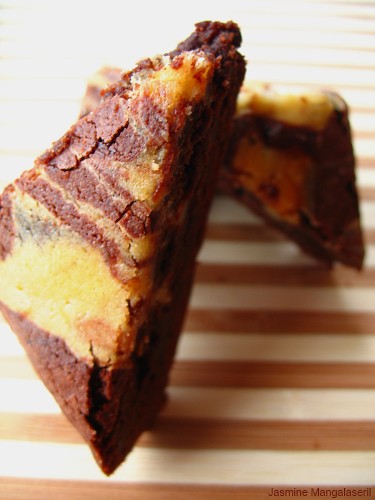
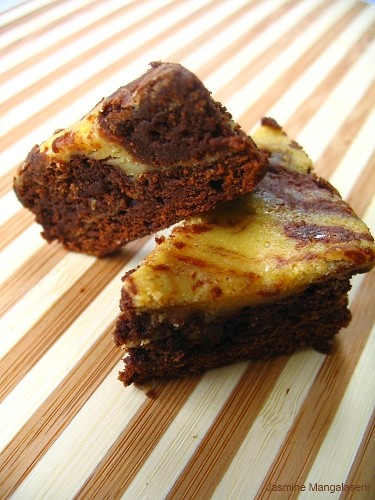
Irish Cream Swirled Guinness Brownies

Undaunted with my less than stunning first attempt at a Guinness-inspired dessert of the year, my next attempt at a stout-soused sweet took me down a more familiar path.

What started as a quest for a simple Irish cream swirled brownie ended with a bit of a bang.

Not literally.

I think every recipe I found was
replicated from our dear Peabody's. It looks like a great recipe and I encourage you to try it if you wish.

Then I got to thinking about the Car Bomb cupcakes which proliferated the web these past few years and decided to play around with that idea: what could be a cupcake could be a brownie.

For those unfamiliar, it's a boilermaker of sorts. Instead of a glass of beer fortified with a shot of rye (or whisky, tequila or vodka), it's Guinness with shots of Baileys Irish Cream and Irish Whisky.

The dozen or so
Guinness brownie recipes I perused seemed to be the exact same one. Then I looked for actual recipes and they all seemed to be Guinness brownies with Irish Cream icing.

Deja-vu all over again.

So I played with a number of the brownie recipes I had on hand, including those above, ATK's chewy brownies and this one from epicurious.com and devised my own version, using Peabody's Irish cream infused cream cheese swirl.

I played. I baked.
I tweeted.

Normally when I tweet my scullery goings on I get a couple of replies along the lines of "Yum!" or "Will there be a post?"

This time the reaction ranged from a chastising because of my apparent political incorrectness, to explanation requests (most people know of the incediary device, not as many know of the drink)--to recipe requests made slightly unintelligible by slurping dribble....followed by impatient proddings for the recipe.

To those insulted by the title: I apologise--the name's inspiration never really dawned on me.


To those who thought I sent away to the Acme Corporation: No--I am not an animated coyote with hate-on for equally animated road runners.

To those who want the recipe: Here it is.

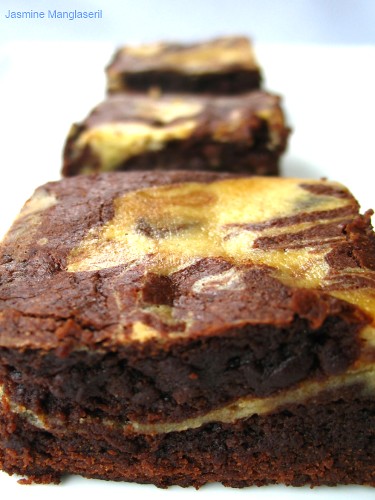
The result is a chewy-fudgey chocolatey, Guinness-kissed brownie. The stout's flavour isn't pronounced, but it adds a bit of depth. I'll be honest and say the fresher (and I would argue temperature has something to do with it) the brownie, the more prounounced the Irish cream flavour (so yes, this is permission for you to eat the entire tray an hour or two after it's come out of the oven).


Irish Cream Swirled Guinness Brownies
Yield: 1 22cm x 22cm (8"x8") pan
Primarily adapted from recipes by about.com, America's Test Kitchen and epicurious.com

Ingredients
For the Irish Cream swirl
85g (3oz) cream cheese, softened
25g (2Tbsp) butter, softened
50g (0.25c) sugar
1 egg
1Tbsp all purpose flour
2Tbsp Irish cream such as Bailey's or Carolans
0.5tsp vanilla extract

For the Guinness Brownies
120ml (0.5c) Guinness or other brand of stout
30g (2 rounded Tbsp) cocoa
90g (3oz) bittersweet chocolate chips (or chopped into small pieces)
25g (2Tbsp) butter, melted
50ml (3Tbsp + 1tsp) flavourless oil
1 egg
1 egg yolk
100g (0.5c) sugar
100g (0.5c) brown sugar
100g (0.66c + 1Tbsp) all purpose flour
0.25tsp salt
1Tbsp Irish Whisky (optional)

Method
Preheat oven to 180C/350C. Create a foil sling for your 22cm x 22cm (8"x8") brownie pan, otherwise line it with parchment. Set aside.

For the Irish Cream swirl:
Beat together the butter and cream cheese. Add the sugar and cream until light and fluffy. Beat in the egg, Bailey's and vanilla and then mix in the flour. Set aside.

For the Guinness brownies:
Bring the stout to a simmer. Take it off the heat and whisk in the cocoa, then mix in the chocolate chips until melted. Stir in melted butter and oil.

Mix in the egg and yolk, then the two sugars and salt. Sift in the flour and give it a good turn until you have a smooth batter.

Dollop in the chocolate and Irish cream batters and swirl them together.

Bake for 30-40 minutes, or until a cake tester inserted mid-way between the edge and the centre point comes out with moist clingy crumbs.

Remove from the oven to cool thoroughly. Brush or spritz the top with Irish whisky, if you wish, before cutting.

Serve on its own, or warmed with vanilla or Irish cream ice cream.

Note:

- You can, if you wish, mix the chocolate (30g bittersweet and 60g semisweet) for a slightly sweeter brownie

cheers!
jasmine


I'm a quill for hire!