Showing posts with label Claudia Roden. Show all posts

15 May 2015

Harissa

150131 Harissa 1

Let's just say these few years have been a bit of a whirlwind of change. From a new employer to being self-employed. From three furry and aged companions to two young and sprightly ones. From one less than stellar love match to another less than stellar love match.  And while I spun about and danced on the latest gust of wind, my posts became perfunctory and infrequent.  A glimpse here, a word there -- only a small number of recipes saw the bluey-white light of my screen, from the trove of potential posts that remain in my mind.

Today's post is one of those recipes that's lingered for months.

I noticed harissa began to pop up more frequently in ingredients lists, but like pretty much every other trend, I didn't pay much attention. It was the new sriracha, making it the new ketchup, making it relatively ubiquitous.  At once it was commonplace and exotic.  Without the time to research or make my own, I excelled at makeshift substitutions, cobbled together with what resided in my sticky-shelved pantry.

Eventually, I found a bottle of it in my swanky specialty shop of choice.  I was disappointed.  It was bitter and bland and bit oily, which belied its "spicy" label.  I continued to use it, spiked with the same residents from my sticky-shelved pantry. The banal was made bearable.

Despite that rather disappointing introduction, I was determined to find out why so many people were enamoured with it. I found my inner Phryne and pored over books and articles. Unsurprisingly, unlike that little overpriced jar from California, real harissa is varied and complex.  Like any homemade condiment, this chilli paste changes from cook to cook, some adding grilled capsicums, others use tomato passata, and still others include rosewater or citrus.

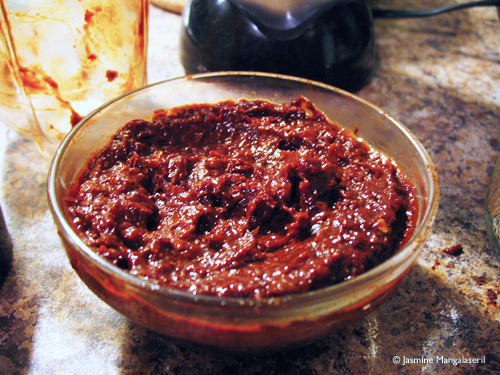
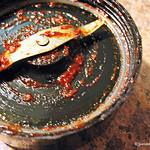
My version is a combination of Paula Wolfert's harous and Claudia Roden's harissa.  The resulting vermillion paste has a pleasing and rounded heat.  While I've been known to spoon a little as a condiment with my dinner, I also use it in marinades and mix it with mayonnaise for frites or beefy sandwiches.  It keeps in the fridge for weeks.


150131 Harissa 3
Harissa 
Adapted Claudia Roden's harissa recipe and Paula Wolfert's harous recipe.
Yield: approx 80ml (1/3c)

Ingredients
1 shallot, thinly sliced
Pinch Turmeric
1 dspn/2tsp 10ml salt, divided
50g (2oz) dried chillies (see notes)
1tsp 5ml whole coriander seed
1tsp 5ml whole caraway seed
1tsp 5ml whole cumin seed
2 garlic cloves
Pinch of cinnamon
2dspn/1-1/2Tbsp 40ml extra-virgin olive oil

Method
Combine shallot with turmeric and 1tsp salt. Cover with cling and let stand at room temperature for an hour (or up to overnight).

Dry toast the whole spices.  Cool before grinding into a fine powder. Set aside.

Rehydrate chillies with boiling water for about 30-45 minutes, until they are soft and pliable. Drain, stem and deseed before giving them a coarse grind. Add the shallots (draining, if necessary) and garlic and continue grinding until smooth. Add the powdered spices, remaining teaspoon of salt and olive oil. Continue grinding until you have a smooth puree. Balance flavours to taste.

Notes
Choose whichever varietal you wish, or create your own blend from a mix of hot, sweet and smokey peppers.  I used roughly equal weights of ancho, arbol, guajillo and pasilla chillies.

cheers!
jasmine
I'm a quill for hire!

25 February 2010

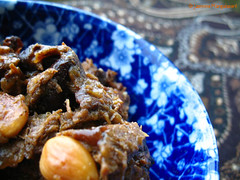
When you give a mouse a cookie II: Lamb, prune and almond tagine with honeyed caramelized onions and couscous

Tag-ine. You’re it.

Sorry. I couldn’t resist.

There was one rule for the potluck: bring something from a cuisine from which you normally don’t eat. Okay. There were two: list the ingredients beside the dish.

I suppose the challenge was easier said than done.

In the week prior to the lunch, I’d already partaken in Scandinavian, Italian, French, Mexican, Southern US, Thai and Vietnamese, along with the ubiquitous “Canadian” fare (foods that if I thought over long and hard I could ascribe to a region, but really: when you’re at the point of gnawing off your own leg, as long as the meal’s ready, edible and within reach, do you really want undertake a genealogical search on what you’re about to put in your mouth?).

Instead of challenging myself to a cuisine, I decided to revisit an underused-in-my-kitchen ingredient, and from that find some sort of national or cultural theme.

I’m not sure why I settled on lamb. As an unashamed carnivore who doesn’t practise ageism (apart from best before dates), I’m fully aware of the controversy of such a choice for a communal meal. But at the same time, it is a favoured meat in so many parts of the world. With so many options that lay before me—Chinese, Indian, the swath of Arabic-speaking nations, countries that lie on the Mediterranean’s northern shore—I decided to throw caution to the wind and simply cook.

Thanks to the genius that is Claudia Roden, I quickly became fixated on Morocco. I’d spent a day in Tangiers two lifetimes ago and fell in love with it as only a 16 year old school girl could. In Arabesque, I found two dishes that immediately leapt to the head of the queue Tagine Bil Barkok Wal Loz and Keskou Tfaya—Tagine of Lamb with Prunes and Almonds and Couscous with Lamb, Onions and Raisins.

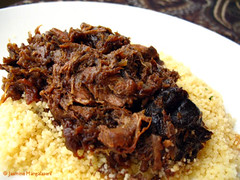
Flicking between the two recipes, I quickly realised they could easily be combined into one. The prunes and almonds would be kept along with the couscous and honeyed caramelised onions. The couscous Claudia calls for is plain, but mine is usually made with stock, whole spices and raisins. A happy marriage of her two dishes, I think.

Moroccan stews or “tagines,” borrow their name from shallow round clay cooking pots with conical lids. If you don’t have the eponymous cooking vessel, you can simply use an aptly-sized lidded pot. Sweet and hearty, tagines of lamb and prune are the most well-known fruit tagines outside of Morocco, and often served with couscous and hot, buttered chickpeas.

Lamb, Prune and Almond Tagine with Honeyed Caramelized Onions

Serves 8

5-6 onions (approx 1.25kg (2.75lbs)),
Flavourless oil
2 garlic cloves, minced
1tsp ground ginger
4 whole cloves, bashed lightly
3Tbsp ground cinnamon, divided
1kg (2lbs) boned lamb shoulder, trimmed of excess fat and cut into 2.5 cm (1”) chunks
Copious amounts of black pepper (start with 3Tbsp)
Salt
Water (approx 1.25L (5c))
400g (14oz) moist pitted prunes
A good, solid pinch of saffron threads (about 0.5tsp)
40g (3Tbsp) butter
1Tbsp olive oil
2Tbsp runny honey
100g (3.5oz) blanched whole almonds
3-4 drops sesame seed oil

Finely chop one of the onions and tip into a large heavy-bottomed pot with four tablespoons oil, garlic, half the ginger, cloves and one teaspoon cinnamon. Cook until the onions begin to turn translucent. Add the meat and brown on all sides. Cover with water, add about two tablespoons of pepper and a few heavy pinches of salt. Bring the pot to a boil and then reduce the flame and leave the meat to quietly simmer for about 1.5-2hrs.

Meanwhile, prepare the caramelised onions. Thinly slice the remaining onions into lunettes, place in a wide, shallow pan with 250ml (1c) water. Cover and cook over a low flame for about half an hour. Unlid, turn up the heat and continue cooking until all the liquid has evaporated. Add the butter, olive oil and stir until the onions caramelise to a warm, deep brown. Mix in the honey, one rounded teaspoon of cinnamon and a good pinch of salt.

Toast the almonds in a few drops of oil until golden. If you wish, you can roughly chop about half the nuts, or leave them whole.

The lamb is ready when it is tender and can be easily pulled apart with your fingers. When so, give the pot a stir (you can remove any scum that's floated to the top, if you wish, but it's not necessary) and add the prunes, remaining cinnamon, saffron, another teaspoon or two of pepper, the caramelised onions and stir again. Let simmer and thicken for 30 minutes.

Taste the thickened tagine and balance flavours to taste. Stir in the almonds and a few drops of sesame oil.

Note: Beef can be substituted for lamb.


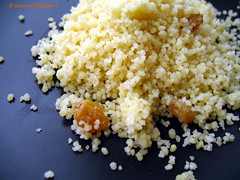
Couscous is semolina made from ground hard durum wheat which is then sprinkled with water and then rolled in flour, and is Morocco’s national dish. The couscous found in Western markets is the pre-cooked, instant variety that requires some boiling water and a relatively short steaming time. Properly cooked, couscous is light and fluffy and can be served with meat or vegetable dishes, or can be sweetened and used in desserts.

Couscous
Serves 8

500g (3c) couscous
Pepper
Salt
A couple of handfuls of sultana raisins
5cm (2-inch) cinnamon stick
4-6 cardamom pods, lightly crushed
600ml (approx 2.5c) vegetable broth, off the boil
2Tbsp flavourless oil
A couple of teaspoons of butter (optional)

Mix the couscous, raisins and spices together and then pour the hot broth over the grains. Mix well. Cover the bowl with cling film, a lid or simply put a dinner plate over top. Let the grains swell for 10 minutes.

Mix in the oil. Rub the couscous between your hands, above the bowl, letting the grains separate and tumble back to the bowl, breaking up any lumps.

Preheat the oven to 200C/400F.

Tip the couscous into an ovenproof dish and pop it into the oven for about 15 minutes (or until it begins to steam). Before serving you can, if you wish, stir in the butter, as you fluff the grains with a fork.

cheers!
jasmine


I'm a quill for hire!


AddThis Social Bookmark Button

21 February 2010

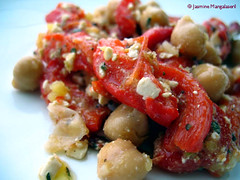
If you give a mouse a cookie Part I: Roasted pepper, chickpea and feta salad

If necessity is the mother of invention, then an inability to sleep is the upstairs neighbour of a busy kitchen.

Which is probably why a caffeine-fuelled evening that led to my inability to sleep, combined with my natural (and I would argue genetic) completionist tendencies, transformed a single-dish potluck offering to a multi-part supper in itself.

It all started when the Toronto panel session I attended ended a tad early. Traffic on the 401 was more than a tad easy. The coffee I had early in the evening kept me more than a tad awake in the-close-to-wee hours.

At home, I did what any normal person would do: I flitted around my kitchen like a hummingbird wired on double espressos, looking for something to do. I didn't feel like baking. Cooking another meal would have been silly as most of the week would have me eat anywhere but home. Alas, it was also too early in the week to prepare my potluck offering.

There I stood, illuminated by the fridge's bulb, pondering its contents. The only thing I could see were bell peppers: the mediumscarymegamart had them on sale so my veggie drawer was full to bursting with oblong orbs.

My potluck muse must have arrived directly from the markets of Tangiers or Marrakesh, sending me into a decidedly Moroccan frame of mind. With North Africa in mind, Claudia Roden's Arabesque offered a solution to my excesses of energy and bell peppers. Her recipe for Felfla Wal Hummas Wa Jban (Roast Peppers and Chickpeas with Fresh Goat's Cheese) was reminiscent of Nigella's roasted pepper and feta starter from Nigella Bites.


Yes, my singular, effortless potluck offering became two relatively effortess potluck offerings. As my Dear Little Cardamummy believes: better to have more food than less.

So there I sat on my kitchen kick stool, at midnight, in front of Beelzebub's window, wearing my white and blue floral printed flannelette granny jammies, occasionally practising culinary voyeurism while reading Nigel Slater's latest tome. I peered into my oven's window as the buckled baking tray encouraged the peppers to rock, roll and wobble in their desert-like heat: their wrinkled and blackened skins spat and oozed boiling juices from blistered gashes. Before my energies dissapated, they were stripped of their char and voided of their seeds, sliced into strips and popped into the fridge to be mixed with chickpeas and their flavourings.


Anyone who didn't know me (and I'm sure those who do) would have thought me mad, I'm sure.

This is easily a pantry dish, especially if you are running late and don't want to roast the peppers yourself and have a favourite jarred offering from your grocer, but you may have to adjust the dressing to make up for the extra sharpness that comes from the vinegar store-bought peppers are packed in.

For a more substantial lunch dish, add chunks of boiled potatoes and perhaps chunks of tinned tuna, with a sprinkling of roughly chopped flat-leafed parsley.

How to roast bell peppers:
Set your oven to its hottest temperature and let it come up to temp. Place whole peppers onto a foil-lined tray and pop into the oven. After 15 minutes, turn the fruit so an unblistered side is foil-down, roast for 10 minutes. Roast remaining sides for 8-10 minutes each.

When done, remove the peppers from the tray and place in a pot with a tight-fitting lid and let steam for about 15 minutes. When the fruit are cool enough to handle, slip off the charred skins from the flesh and remove the stem and seeds.


Roasted pepper, chickpea and feta salad
Serves 8-10

6 roasted red bell peppers, slivered
1x540ml (8.5oz) tin chickpeas, drained
60ml (0.25c) extra virgin olive oil
Juice of one lemon
4 garlic cloves, minced
salt
Pepper
1 Tbsp dried oregano
100g (3.5oz) feta cheese

Make the dressing by combining the oil, lemon juice, garlic, salt, pepper and oregano.

Mix the pepper ribbons and chickpeas together. Pour the dressing over top and give the contents a light stir.

About 10 minutes before serving, mix in the feta cheese.


cheers!
jasmine

I'm a quill for hire!


AddThis Social Bookmark Button

09 April 2007

Feast: Easter Supper

Every Easter supper I try and go for something different, something I've never tried before. This is usually the time for first: the first roast chicken, the first leg of lamb, the first prime rib (etc). This year I was truly at a loss as to what I could do. No, I'm nowhere close to have cooked everything at least once, but I was looking for something a bit more fun than normal.

Then I remembered Meeta's Monthly Mingle theme: Arabian Nights. Apart from the "usual suspects" -- hummus, tabouli, baba ganouj--I've not really done a lot with Arabic-inspired foods. Well, one thing led to another, and I ended up with a hodgepodge of dishes from--or at least inspired from--various areas of the Mediterranean. These ideas and recipes were gleaned from a number of sources--Nigella Lawson, Claudia Roden, Nigel Slater, Delia Smith and a number of web searches:

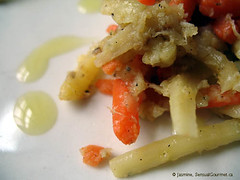
My version of Jazar Bil Camoun Wal Toum (Carrot salad with Cumin and Garlic) used parsnips and carrots. Given my recent Savour the Season post on parsnips and the surprising lack of carrots in my fridge, I decided to make this Moroccan dish using the two veg. Simply blanch 600g of julienned veg, then saute in olive oil, garlic and cumin. Season with salt and pepper and squeeze some lemon over top. Serve cold.

This Lebanese spinach with chickpeas and onions (Sabanekh Bi Loubia) dish is normally made with either black-eyed or haricot beans (and caramelized onions), but I had a tin of chickpeas on hand. Soften an onion in olive oil, then saute garlic in olive oil and add a thawed packet of chopped spinach. Tip in the onions, season with salt and pepper, add the beans and squeeze some lemon over top. Serve cold.

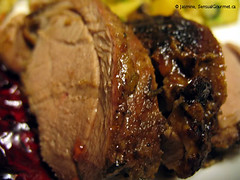
I suppose the lamb is what started things off for this meal. I didn't want to do the standard rosemary-garlic version, but I saw a recipe for a date and mustard-glazed rack of lamb in The Toronto Star. The rub is made with rosemary, cinnamon, salt, pepper, cumin and coriander seed. The glaze used honey-dijon mustard, mashed dates, rosemary, cumin and garlic.


This aubergine and tomato curry is a cross between the most delicious dish my mummy makes and Lebanese aubergines with tomatoes and chickpeas (Mussaka'A Menazzaleh). Toast some black mustard seeds, cumin, coriander, tumeric, chilli pepper and garlic in olive oil and then tip in an onion sliced in half-lunettes and three chopped Chinese eggplants. Saute until soft. Add three or four chopped, very ripe tomatoes and add some water, a pinch of curry leaves, and salt and pepper. Stir in a tablespoon each of red current jelly and rice wine vinegar. Cook, stirring occasionally until it's all soft and oozy. Serve hot.

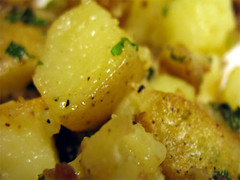
Possibly one of my favourite potato concoctions. I originally thought of it as Greek, but I found a Lebanese version of Roasted potatoes with lemon and coriander (Batata Bel Lamou Wal Cosbara). Boil a kilo of potatoes, chop into a very large dice, toss in olive oil, salt pepper and garlic. Roast at high heat (240C/475F) for about half an hour, or until crispy brown. Squeeze a couple of lemons over top and serve immediately.

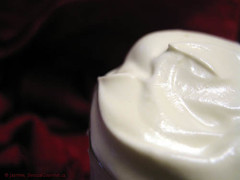
I used this meal as the excuse to try Nigella's Turkish Delight Syllabub. I tried it before TFE and the exbf showed up and decided it was too rich for us...so what did I do (after I took this photograph)? I dumped everything into the ice cream maker and turned it into ice cream. Still too rich, but at least it's now frozen and buys me some time to figure out what I can do with it...right now I'm thinking of turning it into a frosting for a sponge cake.

And yes, here is the 2007 Easter Beanie picture. He wasn't pleased, but he forgave us...and no...he's not usually wall-eyed...I have no idea where that came from.


Cheers!
jasmine

tags:


add this page to del.icio.us