Showing posts sorted by relevance for query pan jam. Sort by date Show all posts

06 April 2009

Blackberry pan jam

Every once in a while I wonder why some produce in the mediumscarymegamart is relegated to the 50 per cent off rack.

Some things I can understand--apples that look as if they were stuffing from Muhammad Ali's punching bag, capsicums so wrinkly no amount of Botox would save them, bags of salad greens that look as if they were dredged from the local patch of wetlands.

Last week I rolled by the rack--they usually have giant bags of still-good mushrooms begging to be sent to a good home. No mushrooms, but four containers of absolutely lovely and almost blemish-and-fuzz-free blackberries (no, not the RIM crackberry). It could have been a mistake--whether "on purpose" (as in staff trying to get cheap food for friends who show up at the *exact* right time), or overzealous stockers trying to get rid of them for whatever reason (really, let's not guess)). But they had the neon pink triangular stickers screaming their affordability...I couldn't say "no" to that, so I bundled four containers into my trolley and went on my merry way to ponder the universes of sweet potatoes, roasting chickens and freezer bags.

Apart from nibbling on them here and there, or tumbling them on ice cream, I realised that I was a greedy guts and bought more than I could realistically finish before they really deserved to be on the discount rack. What to do what to do...

I suppose I could haveItalic frozen them, but nah. I came up with something better (well, for me at least)

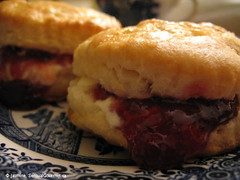
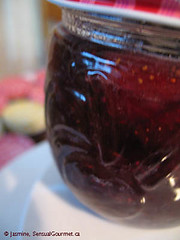
Pan jam, that lovely makeshift jam perfect for small batches of fruit. I suppose you could sterilise a bottle or two and properly preserve them, but when you only have about a cup or two's worth of jam, it's just easiest to keep it in the fridge and have it with your morning toast, on ice cream or enrobe it in bits of leftover pastry (waste not, want not, I suppose).

And yes...whenever I think of or make "pan jam" Ram Jam starts running through my head...always Black Betty...which then makes me crave apple brown betty...with dollops of jam.

The recipe is rather loosey goosey. It is done to taste and is totally based on the sweetness of your fruit. My ratio of fruit to sugar is 10:1 by weight. So, in other words, for 100g of fruit, add 10 g sugar and then adjust if you want it sweeter.

Blackberry pan jam
300g blackberries, rinsed
30g sugar (plus more, if necessary)
a squeeze of lemon, lime or orange
a splash of vanilla
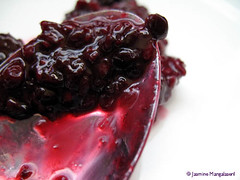
Add fruit and sugar to a pan over a medium hob. Stir together, eventually the fruit gives up its liquid and starts to become...jammy. Taste for sweetness and add more sugar if you want. Stir for about five minutes, add the citrus. Stir for another five-ten minutes, depending upon how thick you want the jam. Stir in the vanilla and decant to a bowl. Store unused jam in the fridge.

cheers!
jasmine


AddThis Social Bookmark Button

27 June 2009

Daring Bakers: Bakewell Tart...er...Pudding

Recipe origins: Traditional (UK)
Inspirations and References: Allan Davidson, Tamasin Day Lewis, Anton Edelmann, Jane Grigson, Nigella Lawson and Jamie Oliver
Hostess:
Me!
My lovely co-hostess: Annemarie of Ambrosia and Nectar

The June Daring Bakers' challenge was hosted by Jasmine of Confessions of a Cardamom Addict and Annemarie of Ambrosia and Nectar. They chose a Traditional (UK) Bakewell Tart... er... pudding that was inspired by a rich baking history dating back to the 1800's in England.

Bakewell tarts…er…puddings combine a number of dessert elements but still let you show off your area’s seasonal fruits.

Like many regional dishes there’s no “one way” to make a Bakewell Tart…er…Pudding, but most of today’s versions fall within one of two types. The first is the “pudding” where a layer of jam is covered by an almondy pastry cream and baked in puff pastry. The second is the “tart” where a rich shortcrust pastry holds jam and an almondy sponge cake-like filling.

The version we’re daring you to make is a combination of the two: a sweet almond-flavoured shortcrust pastry, frangipane and jam.

Bakewell Tart History and Lore
Flan-like desserts that combine either sweet egg custard over candied fruit or feature spiced ground almonds in a pastry shell have Mediaeval roots. The term “Bakewell pudding” was first penned in 1826 by Meg Dods; 20 years later Eliza Acton published a recipe that featured a baked rich egg custard overtop 2cm of jam and noted,

“This pudding is famous not only in Derbyshire, but in several of our northern counties where it is usually served on all holiday occasions.”

By the latter half of the 1800s, the egg custard evolved into a frangipane-like filling; since then the quantity of jam decreased while the almond filling increased.

This tart, like many of the world's great foods has its own mythic beginnings…or several mythic beginnings. Legend has it in 1820 (or was it in the 1860s?) Mrs. Greaves, landlady of The White Horse Inn in Bakewell, Derbyshire (England), asked her cook to produce a pudding for her guests. Either her instructions could have been clearer or he should have paid better attention to what she said because what he made was not what she asked for. The cook spread the jam on top of the frangipane mixture rather than the other way around. Or maybe instead of a sweet rich shortcrust pastry case to hold the jam for a strawberry tart, he made a regular pastry and mixed the eggs and sugar separately and poured that over the jam—it depends upon which legend you follow.

Regardless of what the venerable Mrs. Greaves’ cook did or didn’t do, lore has it that her guests loved it and an ensuing pastry-clad industry was born. The town of Bakewell has since played host to many a sweet tooth in hopes of tasting the tart in its natural setting.

Bakewell tarts are a classic English dessert, abounding in supermarket baking sections and in ready-made, mass-produced forms, some sporting a thick sugary icing and glazed cherry on top for decorative effect.

Enjoy it with a cup of tea or coffee or just eat it sneaky slice by sneaky slice until, to your chagrin, you realise the whole tart has somehow disappeared despite you never having pulled out a plate, fork or napkin with which to eat it.

Is it a tart or is it a pudding?
Someone once said something like “The Bakewell pudding is a dessert. The Bakewell tart is that girl over there.”

It’s a debate that rages on and we aren’t taking sides on this one. But we will say that many people call this pudding a tart.

While we’re at it...
The etymology of pudding is a rather interesting and slightly convoluted one.* The naming confusion may come from the British manner of referring to the dessert course as ‘pudding’ (as well as referring to fat babies by the same name, though we don’t think that is what was the inspiration in this case). And so any dessert is a pudding until another name comes along and adds clarity to what it really is.

* nb: Annemarie had to electronically restrain Jasmine from delving into another treatise, threatening to remove her digital scale, personally autographed copies of How To Eat by Nigella Lawson and A.S. Byatt’s Possession and toss her kitchen footstool into the squidgy marsh up the road (really…Jasmine’s kitchen appears to be designed by a 6’4” fast food-eating engineer named Martin, Chuck or perhaps Buford) Anyone interested in hearing or reading her wax lyrical about puddings should just email her directly.


The Challenge

Rough Durations: Please see individual recipe elements to see how much time you’ll need. You may pull it together in more time or less—it all depends upon your kitchen’s pace. You can complete the tart in an afternoon, or break it up into a couple of days by making the pastry one day in advance.
Measurements: These recipes were developed using weight and not volume metrics, so for better results, pull out your scales. We’ve done our best with the Metric to Imperial conversions.
A giant tart, medium tarts or little tartlettes: We’ll leave that to you.
Mandatory and Optional Elements
Mandatory element 1: Sweet Shortcrust Pastry
Yes, it’s a pie pastry. Don’t look at us like that. It’s sweet and tender and it’s not scary…and we’re encouraging you to do it by hand and put the food processor away (but if you really want to pull out the gadget, go ahead).

Mandatory element 2: Frangipane
We love onomatopoeia of frangipane: it’s rich, sweet and feels slightly luxurious, and can be used in several confections.

Optional element: Home made jam or curd
We know several amongst us are rather jammy with making their own jams and preserves. Go ahead get wild and creative or simply showcase whatever’s local and in season. If you haven’t jammed before and want some hints or recipes, take a look at Bernardin’s homecanning.ca. If you want to just make some jam for this challenge and not go through sterilising jars and snap lids, you can try a pan jam, similar to Jasmine’s Blackberry Pan Jam. If you do use homemade jam, please include your recipe or the link to the one you used in your post.

Bakewell Tart…er…pudding
Makes one 23cm (9” tart)
Prep time: less than 10 minutes (plus time for the individual elements)
Resting time: 15 minutes
Baking time: 30 minutes
Equipment needed: 23cm (9”) tart pan or pie tin (preferably with ridged edges), rolling pin

One quantity sweet shortcrust pastry (recipe follows)
Bench flour
250ml (1cup (8 US fl. oz)) jam or curd, warmed for spreadability (here's the strawberry jam I used)
One quantity frangipane (recipe follows)
One handful blanched, flaked almonds

Assembling the tart
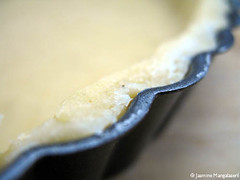
Place the chilled dough disc on a lightly floured surface. If it's overly cold, you will need to let it become acclimatised for about 15 minutes before you roll it out. Flour the rolling pin and roll the pastry to 5mm (1/4”) thickness, by rolling in one direction only (start from the centre and roll away from you), and turning the disc a quarter turn after each roll. When the pastry is to the desired size and thickness, transfer it to the tart pan, press in and trim the excess dough. Patch any holes, fissures or tears with trimmed bits. Chill in the freezer for 15 minutes.

Preheat oven to 200C/400F.

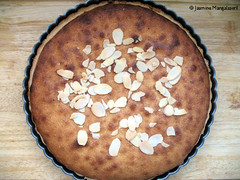
Remove shell from freezer, spread as even a layer as you can of jam onto the pastry base. Top with frangipane, spreading to cover the entire surface of the tart. Smooth the top and pop into the oven for 30 minutes. Five minutes before the tart is done, the top will be poofy and brownish. Remove from oven and strew flaked almonds on top and return to the heat for the last five minutes of baking.
The finished tart will have a golden crust and the frangipane will be tanned, poofy and a bit spongy-looking. Remove from the oven and cool on the counter. Serve warm, with crème fraîche, whipped cream or custard sauce if you wish.

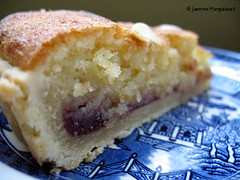
When you slice into the tart, the almond paste will be firm, but slightly squidgy and the crust should be crisp but not tough.

Jasmine’s notes:
• If you cannot have nuts, you can try substituting Victoria sponge for the frangipane. It's a pretty popular popular cake, so you shouldn't have any troubles finding one in one of your cookbooks or through a Google search. That said, our dear Natalie at Gluten a Go Go has sourced some recipes and linked to them in the related alt.db thread.
• You can use whichever jam you wish, but if you choose something with a lot of seeds, such as raspberry or blackberry, you should sieve them out.
• The jam quantity can be anywhere from 60ml (1/4 cup) to 250ml (1cup), depending upon how “damp” and strongly flavoured your preserves are. I made it with the lesser quantity of home made strawberry jam, while Annemarie made it with the greater quantity of cherry jam; we both had fabulous results. If in doubt, just split the difference and spread 150ml (2/3cup) on the crust.
Annemarie’s notes:
• The excess shortcrust can be rolled out and cut into cookie-shapes (heck, it’s pretty darned close to a shortbread dough).

Sweet shortcrust pastry
Prep time: 15-20 minutes
Resting time: 30 minutes (minimum)
Equipment needed: bowls, box grater, cling film

225g (8oz) all purpose flour
30g (1oz) sugar
2.5ml (½ tsp) salt
110g (4oz) unsalted butter, cold (frozen is better)
2 (2) egg yolks
2.5ml (½ tsp) almond extract (optional)
15-30ml (1-2 Tbsp) cold water

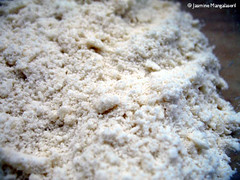
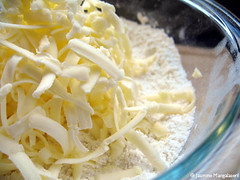
Sift together flour, sugar and salt. Grate butter into the flour mixture, using the large hole-side of a box grater. Using your finger tips only, and working very quickly, rub the fat into the flour until the mixture resembles bread crumbs. Set aside.

Lightly beat the egg yolks with the almond extract (if using) and quickly mix into the flour mixture. Keep mixing while dribbling in the water, only adding enough to form a cohesive and slightly sticky dough.

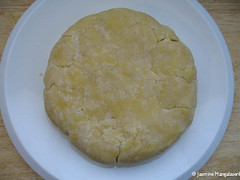
Form the dough into a disc, wrap in cling and refrigerate for at least 30 minutes

Jasmine’s notes:
• I make this using vanilla salt and vanilla sugar.
• If you wish, you can substitute the seeds of one vanilla bean, one teaspoon of vanilla paste or one teaspoon of vanilla extract for the almond extract

Frangipane
Prep time: 10-15 minutes
Equipment needed: bowls, hand mixer, rubber spatula

125g (4.5oz) unsalted butter, softened
125g (4.5oz) icing sugar
3 (3) eggs
2.5ml (½ tsp) almond extract
125g (4.5oz) ground almonds
30g (1oz) all purpose flour

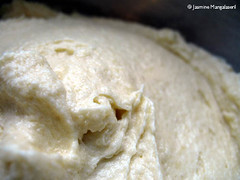
Cream butter and sugar together for about a minute or until the mixture is primrose in colour and very fluffy. Scrape down the side of the bowl and add the eggs, one at a time, beating well after each addition. The batter may appear to curdle. In the words of Douglas Adams: Don’t panic. Really. It’ll be fine. After all three are in, pour in the almond extract and mix for about another 30 seconds and scrape down the sides again. With the beaters on, spoon in the ground nuts and the flour. Mix well. The mixture will be soft, keep its slightly curdled look (mostly from the almonds) and retain its pallid yellow colour.

Annemarie’s notes:
• Add another five minutes or more if you're grinding your own almonds or if you're mixing by hand (Heaven help you).

Special thanks to my dear Annemarie and Ivonne and all the DBs who put together the tart--thanks so much for everything.

Click here for a list of participating Daring Bakers.


cheers!
jasmine

What I'm reading: The Secret Agent by Joseph Conrad

I'm a quill for hire!



AddThis Social Bookmark Button


18 January 2008

In a jam

I've always found mindless repetition the panacea to the troubles that weight my mind. Washing dishes, polishing shoes, even alphabetising my shelves let my hands busy away, and my mind consider scenarios and reasonings, break through writer's block or even do simply nothing...to temporarily attain a much-needed respite from life's woes and stresses.

Easy and attainable therapy, I think.

A few months ago when I found myself as impotent in the kitchen as a eunuch in the Playboy Mansion, I turned to the restorative powers of automatic action. I tried favourite recipes--brownies, cakes--but the disappointing results added to my grief. It was late summer-early autumn when the markets were bursting with the last of hot season berries. Even though I could freeze them for later consumption, I felt as though I was admitting culinary defeat at a time when I should have been exploring my scullery's capabilities.

I suppose in such times it's easy to dwell on what one ought to do, as opposed to what one wants to do. This time, the ought and want melded into what became a bit of a tiger: instead of letting the last of Ontario's strawberry crop remain in their punnets for someone else more capable than I to handle, I bought the last remaining fruit and whisked them home to ponder their fates.

It had been years since I made jam or preserves of any kind. In fact the last bit of canning I did was in my last year at uni when I made some sweet and sour apple chutney as Christmas prezzies. Why on Earth I decided to get into jam-making escapes me. Perhaps it was a yearning to be part of something that was at once intimate and grand. Intimate because it happens in my kitchen with one other (in my case, Dear Little Mummy); grand because it carries both a sense of occasion (getting all the gear ready) and the knowledge that hundreds of other households also put away glinting bottles of sweet preserves.

After reviewing my books and my mother's clippings, I decided on Nigella's version for three reasons: it didn't use bought pectin; it offered the romantic potential of suspended berries visible through the jars' glass walls, and it used balsamic vinegar.

Quite honestly, I don't know how many bottles we made that weekend. Several batches, anyhow. It was easy and filled the kitchen with a heady almost candy-like aroma. Let's not overlook the decidedly therapeutic benefits of stirring and skimming.

The end results were jars filled with garnet jewels--not too sweet and nicely set. Many bottles were given as appreciation gifts to friends who helped me through these past few months, but between Mummy and I we held back about half a dozen bottles. Mine are squirrelled away and consumed carefully--sometimes on buttered toast or scones, sometimes on vanilla beaned ice cream, sometimes just on its own.

It will be months until we get such beautiful strawberries again.

Strawberry Jam
from Nigella Lawson's How To Be a Domestic Goddess

675g hulled strawberries (some can be chopped, others can be left whole)
700g sugar
2Tbsp lemon juice
1tsp balsamic vinegar

Sterilise four 200 ml jars and place a saucer in the freezer.

Put all the ingredients in a wide, heavy-bottomed saucepan and stir with a wooden spoon, until all the fruit is coated.

Put the pan on low heat and bring the berries to a boil, stirring occasionally. When it comes to a boil, let it blurble away for about eight minutes, and skim the froth off the top.

Check its set after five minutes and again every five minutes or so. To do this, put a bit of the jam on the saucer, let the jam cool a bit and give it a bit of a push with your finger. If it wrinkles and you can make a line with your finger, it's probably good to go (think of how you test custard using a wooden spoon).

Decant into sterilised jars.


cheers!
jasmine


19 December 2010

Twas the week before Christmas

And all through these weeks,
I've been up to my eyeballs,
In cookies and treats.

Okay...that's all I can muster.

Needless to say December has been a whirl of lunches and dinners (some less edible than others), gatherings, treats and nights in the kitchen fighting with Beelzebub to procure 500 cookies. The next few weeks will bring much the same (except no more cookies--if you've not received any...well...umm...be nicer to me and we'll see if you get on next year's list).


I've had a couple of requests for recommendations for books for foodies. I receive a number of food related books to review each year--not everything gets a post, but I did select a couple which I've not yet reviewed but deserve to be mentioned. Both were given to me courtesy of their publishers:

by Tilar Mazzeo
Harper Collins
254pp/C$33.99
Mazzeo tells the story of a young widow, assumes the helm of what would become one of the world's most famous champagnes. Tracing Mme Cliquot's story from revolutionary to Napoleonic France, the author deftly combines socio-political events with the personal struggles of a young widow, mother and business woman.


by Harold McGee
Doubleday Canada/Random House Canada
576pp/C$42
McGee's latest tome easily takes the home cook by the hand and guides them through the basics of cooking and more important why recipes work (or more importantly, don't work). He guides the the reader though tools, concepts and ingredients in simple, straightforward language. I think it would be good for those who are rather new to the kitchen and it's frustrating ways.

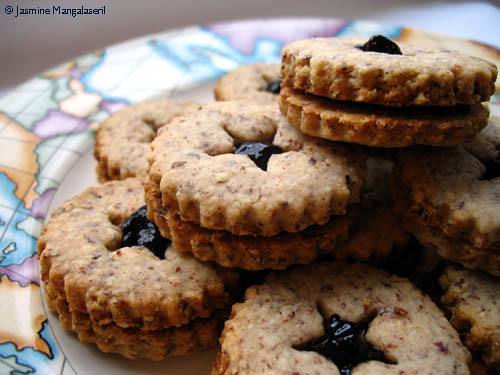
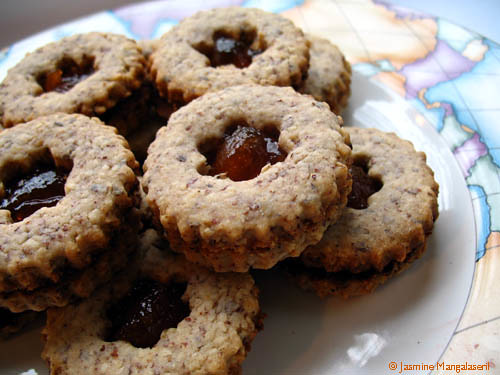
So, that's it for me until the New Year. Until then, I'm leaving you with a plate of linzer sandwich cookies: nutty, sweet and flavoured with cinnamon and cloves.

The recipe is from Canadian Living's cookie edition. The only real change I made was to use preground filberts--I don't have a food processer, so I bought a packet of ground nuts and went to work. The recipe comes together nicely and is so easy to work with...and, unlike other cookie doughs, you can easily re-roll the scraps withouth the finished cookie toughening.

Linzer Cookies
Adapted from Canadian Living's recipe
Yield three dozen
Ingredients
215g (1.5c) ground filberts (hazelnuts)
240g (2c) ap flour
1tsp baking powder
1.5tsp cinnamon
0.25tsp ground cloves
0.25tsp salt
grated zest of one lemon
280g (1.25c) butter
150g (0.75c) sugar
1 egg
1 egg yolk
1tsp vanilla
250ml (1c) jam (raspberry, apricot, strawberry, blueberry, whatever you have on hand)

Method
Toast the ground nuts either by spreading it in an even layer on a tin foil-lined cookies sheet and popping it into a 180C/350F for about five minutes or until golden and fragrant OR toast the flour in batches on the stovetop, over a medium heat, in a large cast iron pan until golden and fragrant.

Mix toasted ground nuts with flour, baking powder, spices, salt and lemon zest.

In a separate bowl, cream together butter and sugar. Then beat in the vanilla, the whole egg and yolk one at a time. Stir in the nut flour mixture in two or three additions, until the dough comes together, without over mixing. Divide the dough in half and flatten into discs. Wrap with cling film and refrigerate for at least one hour.

Preheat oven to 180C/350F and line cookie sheets with parchment.

Roll out each disc onto a lightly floured surface to 0.5cm/0.25" thickness. Using a 6cm (2.5") round cutter. If desired, use a smaller cutter to cut a shaped hole from half the cookies (for the tops).

Bake 2.5cm (1") apart for 8-12 minutes, until the bottoms are lightly golden. Let cool on pans for a few minutes before transferring to racks. Let cool thoroughly before sandwiching.

Option: dust with icing sugar before serving.

To assemble:
Spoon a teaspoon of jam onto the bottom of a "bottom" biscuit and sandwich with a top.

Notes:
- I've not tried it but you can probably substitute other nuts for filberts, such as walnuts or almonds.
- For crispier cookies, sandwich the day your are serving them, otherwise the the jam will soften the cookies, the longer they've been assembled. Nothing wrong with that...

cheers!
jasmine


AddThis Social Bookmark Button

30 March 2008

Daring Bakers: Perfect Party Cake

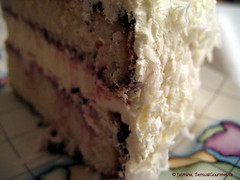
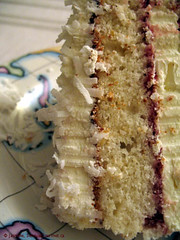
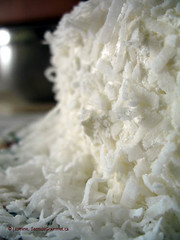
Everytime I idly leaf through Dorie Greenspan's Baking: from my home to yours, I stop at page 251 and sigh. It's one of those lovely compositions--slices of white cake, sandwiched between garnet layers of rasperry jam and white buttercream frosting, encased in a snowfall of shredded coconut.

I look at it and think "My, that's pretty...I really should make that some day," and then go off to a different recipe.

When I've charged myself with baking a birthday cake, I flip through this marvellous tome and think "My, that's pretty...I really should make that some day," and then go off to a different cake.

So when our fabulous Daring Bakers host, Morven of Food Art and Random Thoughts revealed this month challenge as Dorie's Perfect Party Cake, I knew my days of wistfully dreaming of whipping up so lovely a creation would be a memory as now this celebratory crumb will have come from my kitchen...or a version of it.

The Perfect Party Cake is not hard to make as Dorie's wonderful prose easily walks you through the steps: two divided slabs, some seedless jam, a mound of Swiss meringue buttercream frosting, all patted down with coconut flakes. Everything about this cake is delicious--the crumb has nice, light flavour and a soft texture. The frosting is sweet but neutral and plays nicely with the lemon, raspberry and coconut.

But the thing is...I'm not a foofy cake person.

And by this I mean any cake that you need to primp and fuss over. I have an ingrained and genetic aversion to crumbcoats and piping bags, which extends to layer cakes.

Just give me a single, naked slab and a fork and I'm more than happy--you don't even have to give me a fork, but mummy taught me that cake is not finger food. If I'm feeling fancy, a plop of ice cream is perfect accompaniment. If I'm bothered to ice a cake, I prefer something that takes relatively little effort--plop and smoosh, plop and smoosh. Easy peasy, pudding and pie.

So here I am, dared to make a slightly foofy, definitely layered cake. It's more than layered--its two baked slabs, split to make four layers. And here I am, even and level-cake slicing challenged. Really...most of my attempts at such beasts have produces wobbly-cut layers whose serrated tops (or bottoms) resemble the bloop-bloop heart monitor machine display screens. At best they are only cut on a diagonal. I don't even pretend the layers will be the same thickness.

But like a true DBer, I put all the above aside and tackled the cake.

I baked twice for this challenge--and by doing so, broke my personal DB rule: one shot, good or bad. My first attempt was during my migraine weekend, during a small relatively pain-free windo. As soon as I took them out of the oven, I set them on the rack to cool and then the searing aches returned and I slunk off to a dark room. Two days later, the slabs were still there...cool but stale. I looked at them--they didn't rise...at all. I blamed Beelzebub and decided to try again later.

Between attempts I'd read various DB accounts, many complaining that the slabs didn't rise. What? Were they all coming into my kitchen when I wasn't around and using the kitchen squatter? Given I just got my power bill, I can (thankfully) say no. A few people thought their leveners were at fault. That could have been my issue, but I use my BP regularly and haven't had any problems with lift before. I read and re-read the recipe in my book and as far as I can tell, I followed everything to the letter.

This, of course, lead me to break a real DB rule...I decided to not follow the recipe to the letter. I used the same ingredients, in the same quantities, but just a little differently. Plus, I decided to switch pan sizes, using my more standard 20cm (8") tins instead of the 23cm (9") ones called for.

So...what did I do differently?

  • I whipped the egg whites separately from the buttermilk, with a bit of sugar so I had lovely billowy, soft-peaked marshmallowy clouds.
  • Instead of sifting all the baking powder with the flour, I held back about a teaspoon's worth.
  • Just before pouring the buttermilk into the batter, I stirred in the reserved bp, to activate the leavening properties
  • When adding the wet to the dry, my first addition was half the buttermilk the second was the remaning and the third was folding in the egg whites.
  • VERY QUICKLY put the tins into the oven.

Well...the cakes were higher (some of which is attibutable to the volume issue by switching to the smaller tins, but I think my procedural changes helped a bit), but not high enough for me to feel comfortable about bisecting them adequately. I think if I were using a better oven, I would have had better height.

Because I switched it to a two-layer cake, I wound up with a lot more frosting than I needed, so I...umm...made a very thick layer of frosting in between the cakes. Not so thick as it would have replaced a proper third (or fourth) layer, but thicker than I'd normally do.

Of course, after I completed it, we got a note from Dorie suggesting that people use plain flour (just take away two tablespoons of flour from the mix) or a particular brand of flour. Since that note, I noticed the number of triumphant DBers increased. Ah well...it was still a good birthday cake for the exbf.

I do want to try this one again with that flour brand, the ap subsitute and my regular brand. I'm just not sure what do do with all that cake...


To read what the other DBs did with this challenge, take a meander through our blogroll.


cheers!
jasmine


Related Post: Redux: DB: Dorie's Perfect Party Cake


AddThis Social Bookmark Button

18 January 2009

A tart for Jerry

Oh my word. How may I adequately thank our dear Jerry of Cooking by the Seat of My Pants?


A couple of months ago he sent me a note, asking for my snailmail addy because he had a little bit of Christmas love to send my way. Gosh.


Jerry and I "met" a couple of years ago, when he was still a newish foodblogger. He sent me a note and I rambled on and on and on (anyone who emails me knows that they run the distinct risk of receiving anywhere from a one-word reply to upwards of a 2 000 -word treatise).


I love hearing from new bloggers and people who want to be bloggers (foodish or otherwise). Sometimes they just want to say "hi," sometimes they've got technical questions, sometimes they need a little moral support or a big kick in the electronic tushie to get going and put their thoughts and creativity to pixels. I do my best to impart whatever it is I can and when I can, I'll peek at what they're doing. It's all about paying it forward, my friends.

Jerry's one of the regular ones I keep an eye on. Not only is he a dear soul--supportive, bright and creative--his foodish passions are expressed so well. If you've not visited it, by all means take a look.


Anyway, Jerry sent me a little box of goodies as a way of thanking me for my supportive words early in his blogging career. As usual, Canada Post decided to have its way with my foodish giftie and deposited it into the infernal Supermailbox well into January. (I swear...there must be a notice in the Postie lunch rooms across Canada telling them to withold any and all parcels destined for me because there's a good chance there will be food...good food...in the box. I think I'm running a 50 per cent delivery rate...and of course, when you ask them about this, the *lovely* people at the Post Office tells you it was delivered. They just don't tell you to where it was actually delivered...this marks the end of this round of my Canada Post rant.)


So, how to thank such a kind and sweet soul for his time and efforts to the e-foodish world, as well as the support he gave me last year?


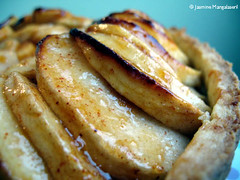
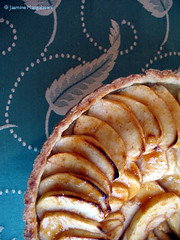
Well...I do the only thing I can...and make him a treat. I've been hankering to do a tart for a while--a return to my tarty ways, I suppose and after some pondering, I came up with a simple and lovely apple tart.


I normally do a traditional double-crusted apple pie, but my pastry skills have atrophied quite a bit...definitely not up to gift-giving snuff. So, instead of a flaky-crusted pie, my sights turned to a sweet shortcrust tart.


The crust itself is closer to a shortbread-type dough, fortified with egg yolks. Sweet, crisp and just lightly scented with vanilla, even the most nervous pastry maker can turn out a lovely tart.


I'm a bit of a fan of caramel apple pies, but for something like this, I wanted just a hint of caramel, so after par-baking the crust, I slathered a couple of spoonfuls of dulce de leche on the base. The apples were zhuzhed a bit with cinnamon and spritzes of orange juice before fanning onto the sweetened, sweet crust. After those slices' edges have bronzed, and the tart is removed from the oven, brush melted apricot jamp over the still warm fruit.

Thank you so much, Jerry. You are an absolute gem.


Apple Tart

For one 23cm/9" tart

One recipe, sweet shortcrust tart, par baked (recipe follows)
2 bulgey teaspoons of dulce de leche or caramel sauce
3-4 apples, depending on the size of the apples, peeled and sliced into wedges
the juice of one orange
sugar
0.5 tsp cinnamon
melted apricot jam for glazing

Preheat the oven to 180C/350F.

Roll the pastry to about .8cm thickness and lay in the tart pan. Trim the edges and dock the bottom before parbaking for 10 minutes. Brush the base with dulce de leche.

Combine the apples, juice, a few spoons of sugar and cinnamon. Fan the apples onto the pastry. Cover with tin foil and bake for about 20 minutes. Remove the foil and continue baking for another 15-20 minutes, or until the crust is golden and the apples' edges are bronzed.

While still warm, brush fruit with melted jam.


Sweet Shortcrust Pastry for one 9" tart
225g ap flour

110g Butter
2 Beaten Egg Yolks
30g Sugar
0.5 tsp Vanilla Salt
0.5 tsp Vanilla paste
1-2 Tbsp Water

Sieve the flour, sugar and salt together into a bowl. Then grate the butter into the flour and rub lightly until the mixture resembles breadcrumbs. Stir in the yolks, vanilla paste and water, until a soft but not sticky pastry is formed.

Wrap tightly in cling and chill for about half an hour.


cheers!
jasmine


AddThis Social Bookmark Button


12 September 2010

A Cake is Announced: Delicious Death

I always find my blog’s inbox completely irresistible.

Here are grouped together, all higgledy-piggledy, notes from readers and stoppers-by with questions or comments, frenzied appeals to publicise charitable events, PRs and marketers looking for a cheap and easy way to gain pixel space for their clients, and subject lines asking me if my Mr. Winkie needs improving.

This particular Wednesday, September the eighth was no exception to the rule (well, apart from notes of well-wishing for both this blog’s anniversary and another notable event). And so it was with great interest while sipping my tea and nibbling a foofy pink cupcake, I perused
Mailwasher’s preview pane, I noticed lying betwixt newsletters and messages imploring me to try “it” now for the purposes of shocking friends with my tool, I spied the following notice: A cake is announced and will be available to celebrate Agatha Christie’s 120th birthday on 15 September, and will be available a Brown’s Hotel in Mayfair during Agatha Christie Afternoon Tea the week of 12-19 September 2010. *

My, it was like my inbox was like the North Benham News and Chipping Cleghorn Gazette.

Further reading truly got my heart racing. No, the cake would not be prepared by or served by
Lucas Bryant (my current actor crush). For you see, this was not just any cake, but one created by Jane Asher, inspired by "Delicious Death," Mitzi's celebrated dessert in A Murder is Announced.

Its description is only this, in Mitzi's own words:


"Yes. It is rich. For it…I need for it chocolate and much butter, and sugar and raisins….It will be rich, rich, of a melting richness! And on top I will put the icing--chocolate icing--I make him so nice...These English people with their cakes that tastes of sand, never never, will they have tasted such a cake. Delicious, they will say--delicious--"
How a propos that the Queen of Crime nickname a mysterious cake "Delicious Death."

Recipe in hand, I set out to bake the cake. If you followed
my Twitter feed this past weekend, you're well aware of my skirmish with the kitchen gods.
If you didn’t (and really, I’m not sure whether to be hurt that you don’t clamour for my every online word or congratulate you for having better things to do than follow my often disjointed140-character missives), this was the fate of that first cake:


Yes.

It fell.

To the floor.

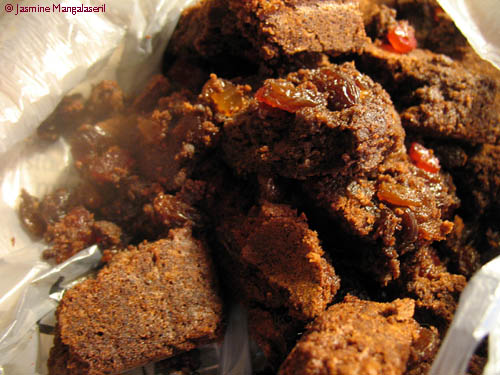
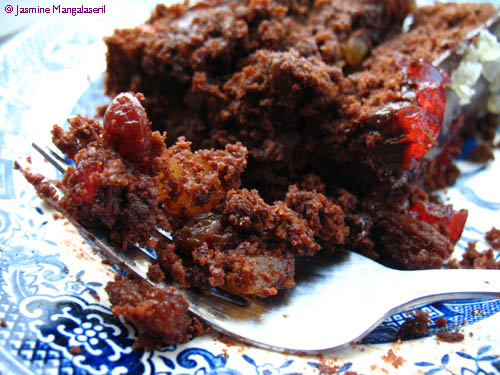
Dismayed, I collected the hunks of crumb, and still glistening confettied dried, preserved and sugared fruit off the floor. It was very much a lovely tribute not only to the story, the lady but also post-war rationing and baking traditions in England but also from somewhere in the middle of Europe. This was not a light and tender, buttery crumbed floury cake as many of us are accustomed to, but a more substantial cake gilt with chocolate, dried fruits and fortified with brandy (or rum, if you prefer). It is not a fruitcake, but could easily turn into one by folding the fruits into the batter before baking.

I tasted it before binning it. The cake was chocolaty and moist with a nutty undertone from the ground almonds. It was, as suspected, sweet. Cloyingly so. Between the sugar in the cake, the sugar in the filling and the sugar in the glaceed cherries and crystallised ginger, I buzzed around my kitchen like a little humming bee.

I checked my ingredients. What I didn’t have I’d simply substitute for or use a reduced amount. I faithfully followed the recipe once. This second time I would play a bit, based on what I had on hand and my assessment of the first attempt. My recommended tweaks are in the baker’s notes following the recipe.

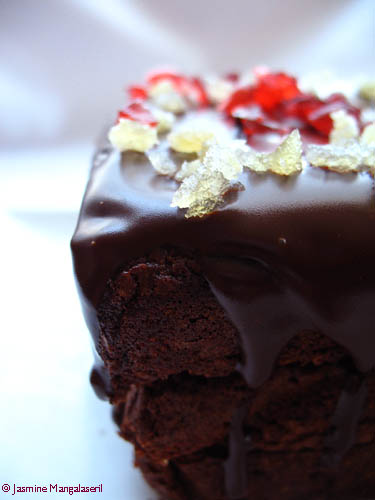
To me this cake is not the wedge-serving kind, but instead one where squarish slices are sliced off. So I baked it in a 21.5cm (8.5”) loaf pan. Since I could not find candied flower petals, nor was I willing to pay for gold leaf. and I was besotted by the jewel-like translucency of the glaceed cherries and crystallised ginger, I decided to mince some of each and strew them on the ganache glaze.

Regardless if you choose to bake the original or tweak it, it is a lovely little cake. It’s equally at home to be brought out for an afternoon coffee or tea, but also as a festive dessert.

Delicious death? I wouldn’t have it any other way.


Agatha Christie’s Delicious Death
by Jane Asher; Imperial/volume conversions by me

Ingredients
175g (1c) dark chocolate drops (50-55% cocoa solids)
100g (7Tbsp) softened or spreadable butter
100g (0.5 c) golden caster sugar
5 large eggs
½ tsp vanilla extract
100g (1c) ground almonds
½ tsp baking powder

For the filling:
150ml (10Tbsp) rum, brandy or orange juice
150g (1c) raisins
55g (0.33c, packed) soft dark brown sugar
6-8 glace cherries
4-6 pieces crystallized ginger
1 tsp lemon juice

For the decoration:
175g (1c) dark chocolate drops (50-55% cocoa solids)
150ml (10 Tbsp) double cream
2 tsps apricot jam
10g crystallized violet petals
10g crystallized rose petals
1 small pt of gold leaf.

Method

Pre-heat the oven to 150degC, (300degF, 135degC fan assisted). Grease an 8” deep cake tin and line the bottom with baking parchment or silicone.

Prepare the filling: in a small saucepan, combine all the ingredients and stir over heat until the mixture is bubbling. Allow to simmer gently, while stirring, for at least 2 minutes, or until most of the liquid has evaporated and the mixture is thickened. Allow to cool.

In a small heatproof bowl, melt the chocolate drops over simmering water or in a microwave, being careful not to let it overheat. Set aside to cool for a few minutes.

Using an electric mixer, cream the butter and sugar together in a large bowl until very pale and fluffy. Separate the eggs, setting aside the whites in a large mixing bowl, and, one by one, add 4 of the yolks to the butter/sugar mix, beating well between each one.

Add the melted chocolate and fold in carefully, then stir in the vanilla extract. In a separate bowl, mix together the ground almonds and baking powder, then stir them into the cake mix.

Whisk the egg whites until peaked and stiff, then fold gently into the chocolate cake mix.

Spoon the mix into the prepared cake tin, leveling the top, and bake on the middle shelf of the oven for 55-65 minutes, or until firm and well risen. Allow the cake to cool in the tin for 10 minutes before turning it out on to a rack to cool completely.

Using a serrated knife, slice the cake in half horizontally. Spread the cooled fruit filling onto one half and sandwich the two halves back together.

To decorate: put the chocolate and cream in a heatproof bowl and melt them together over simmering water or in a microwave. Spread the cake all over with warmed apricot jam and place on a rack over a baking tray. Keeping back a couple of tablespoonfuls, pour the icing over the whole cake, making sure it covers the top and the sides completely, scooping up the excess from the tray with a palette knife as necessary. Add any surplus to the kept back icing. Carefully transfer the cake to a 10” cake board or pretty plate.

Once the reserved icing is firm enough to pipe, place it in a piping bag with no. 8 star nozzle and pipe a scrolling line around the top and bottom edges of the cake. Leave for 2-3 hours, to set.

Place the violet and rose petals into a plastic bag and crush them into small flakes. Sprinkle these liberally around the chocolate scrolls. Finally, with a cocktail stick, pull off some small flakes of gold leaf and gently add them to the top of the cake.

Jasmine’s Notes:

  • Chocolate: If you cannot find chocolate chips with the cocoa solids percentage listed on the packet, look for bittersweet chocolate chips.
  • Double cream: Double cream can be difficult to find in Canada (I only manage to find it at Christmas). It has 40% fat and can be substituted with whipping cream (heavy cream), which is 35% fat.
  • Caster sugar is the same as superfine sugar.
  • If you wish to make this a loaf cake, use a 21.5cm (8.5”) loaf pan and bake at 150C/300F for 65-75 minutes.

My tweaks to the original filling
 30ml (2Tbsp) Cointreau, plus extra for assembly.
 75g (0.5c) raisins
 1Tbsp soft dark brown sugar
 8 glace cherries, minced
 6 pieces crystallized ginger, minced
 1 tsp lemon juice
 a pinch of salt
 1tsp butter

While you mix the cake, soak the raisins, cherries and ginger in water, to remove as much of the excess sugar as possible. Drain the water. After the cake is done, mix 2Tbsp Cointreau with the remaining filling ingredients and bring to a simmer over medium heat to let the alcohol evaporate and the liquid thicken. When assembling the cake, brush or sprinkle the slices’ surface with Cointreau.

Original recipe reproduced with permission.

AGATHA CHRISTIE and DELICIOUS DEATH are registered trade marks of Agatha Christie Limited (a Chorion Limited company). All rights reserved.

Visit http://agathachristie.com/ for more information about the author and the celebrations marking her 120th birthday.

* With apologies to Dame Agatha and all her fans. I couldn't resist.

cheers!
jasmine


I'm a quill for hire!


AddThis Social Bookmark Button

01 August 2010

Mmm...Canada: Food Day: Blueberry-apricot frangipane tart

I heart July. It starts with Canada Day and, this year, it ends on Food Day.

It celebrates what we eat and how we eat it. It highlights what's here naturally, from fish and shellfish, to beasts and birds to crops and wild fruits and veggies. It recognises each crop and herd brought by waves of immigrants from cows and pigs to wheat and from indigenous foods to crops and herds brought over with each successive immigration wave.

Mmm...Canada. We are a nation of lucky eaters.

Admittedly, the vast majority of my foodbuying happens in megamarts of varying sizes. When I can, from spring until autumn I travel out past the roundabout to Herrle's in St. Agatha. They're a local treasure, known for having the best produce grown either by the Herrle family or by other local or close-to-local growers.

The market itself evolves as the seasons do. You won't find corn in April and it's highly unlikely saskatoon berries will offered in August. Here even the most removed from food cycles are aware of the specialness of the produce: deep red tomatoes heavy from their juices, signs leading shoppers to the freshest-picked beans at the back of the store, gaggles of shoppers at bins of their famous corn, their arms filled with ears destined for a pot of water or for the barbecue. It's not like my usual megamart.

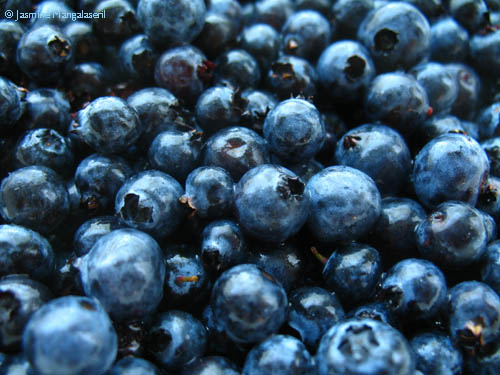
Yesterday I made a point of heading out to St. Agatha. I returned with a bagful of goodies: yellow and green courgettes, tomatoes, sweet potatoes, apricots and wild blueberries. I'll probably beg My Dear Little Cardamummy for guidance in replicating her courgette and tomato curry and the sweet potatoes will be roasted. But the fruit?
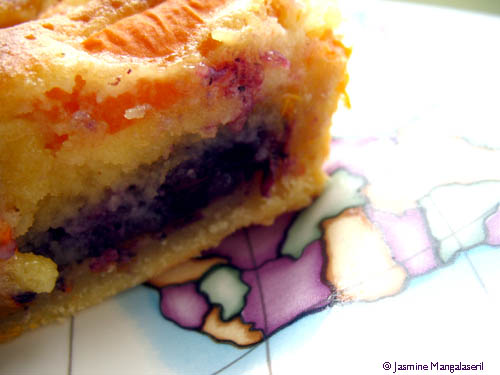
The weather has cooled off a tad and this Jasmine no longer wilts in the heat and humidity. As a result turning on the oven isn't arduous, but a pleasure. Especially when a tart is to be had.

This tart is a variant of the Bakewell Tart Daring Baker's challenge I hosted last year, ably assisted by my dear Annemarie of Ambrosia and Nectar: but this time the frangipane is sandwiched between fruit layers atop a sweet shortcrust.The resulting rich, sweet nuttiness is perfect for sharing on a day that celebrates food.

Blueberry-Apricot Frangipane Tart
Makes one 23cm (9") tart

One quantity sweet shortcrust pastry (recipe follows)
Bench flour
2Tbsp apricot or blueberry jam, warmed
One quantity frangipane (recipe follows)
200g (1c) (wild) blueberries, rinsed and picked through
5-10 apricots, sliced into eight wedges each.

Crust:
225g (0.75c+ 3Tbsp) ap flour
2Tbsp sugar
0.5tsp salt
110g (0.5c) unsalted butter, cold (frozen is better)
2 egg yolks
1-2 Tbsp cold cream

Frangipane:
100g (7Tbsp) unsalted butter, softened
100g (0.5c) sugar
2 eggs
2.5ml (½ tsp) almond extract
100g (1 scant cup) ground almonds
3Tbsp all purpose flour

For the crust:
Sift together flour, sugar and salt. Grate butter into the flour mixture, using the large hole-side of a box grater. Using your finger tips only, and working very quickly, rub the fat into the flour until the mixture resembles bread crumbs. Set aside.

Lightly beat the egg yolks and quickly mix into the flour mixture. Keep mixing while dribbling in the cream, only adding enough to form a cohesive and slightly sticky dough.

Form the dough into a disc, wrap in cling and refrigerate for at least 30 minutes

Place the chilled dough disc on a lightly floured surface. If it's overly cold, you will need to let it become acclimatised for about 15 minutes before you roll it out. Flour the rolling pin and roll the pastry to 5mm (1/4”) thickness, by rolling in one direction only (start from the centre and roll away from you), and turning the disc a quarter turn after each roll. When the pastry is to the desired size and thickness, transfer it to the tart pan, press in and trim the excess dough. Patch any holes, fissures or tears with trimmed bits. Dock the crust with a fork and chill in the freezer for 15 minutes.

Preheat the oven to 200C/400F. Line the tart tin with foil and pour on the baker's beans. Bake for about 10 minutes.

For the frangipane:
Cream butter and sugar together for about a minute or until the mixture is primrose in colour and very fluffy. Scrape down the side of the bowl and add the eggs, one at a time, beating well after each addition. The batter may appear to curdle. Pour in the almond extract and mix for about another 30 seconds and scrape down the sides again. With the beaters on, spoon in the ground nuts and the flour. Mix well. The mixture will be soft, keep its slightly curdled look (mostly from the almonds) and retain its pallid yellow colour. Set Aside

Assembling the tart:
Spread as even a layer jam onto the pastry base. Tumble the blueberries on top. Slather on the frangipane, spreading to cover the entire surface of the tart. layer the top with as many of the apricot wedges as possible (depending upon the size of your slices, you'll probably have leftovers. Just eat them).

Pop into the oven for 30-40 minutes. The frangipne will poof from between the fruit slices, brown and set.

Remove from the oven and cool on the counter. Serve warm, with crème fraîche, whipped cream or custard sauce if you wish.

When you slice into the tart, the almond paste will be firm, but slightly squidgy and the crust should be crisp but not tough.


cheers!
jasmine


I'm a quill for hire!


<span class=AddThis Social Bookmark Button" src="http://s9.addthis.com/button1-bm.gif" width=125 height=16>