13 June 2008

Mmm...Canada: A wee bit of inspiration

Jennifer and I have received great response from people who've found out about Mmm...Canada, both savoury and sweet--and we're looking forward to reading about how Canada tastes to them.

At the same time, I've received notes from people who'd like to participate, but because they've never visited Canada, they're not sure what "Canadian food" is.

Well, you know...there are Canadians who aren't sure they can answer that question, so don't get too stressed about it (okay, I don't expect anyone to get stressed about it...this is supposed to be fun, and hopefully tasty).

Here's where I'll try and offer a bit of guidance. Instead of only giving you links to sample dishes, I'll just give you some raw ingredients...all Canadian-grown...All you need to do is be creative in how you use them. This by no means is a complete list, so if you know of something that I'm missing or you think would be a good addition, please leave a comment...

Dairy & Eggs

  • You probably don't need me to tell you about eggs, cheese, cream, milk, sour cream or yoghurt...and not all dairy products are made with cow's milk
  • You should know that we've a rich cheesemaking history.

Fish & Seafood:

  • Cod
  • Dulse (okay, it's a veg, but still)
  • East Coast Diver's Scallops
  • Halibut
  • Herring
  • Lobster
  • Manitoba Gold Eye
  • Pacific oyster
  • Pickerel
  • Prawns
  • Salmon
  • Trout
  • Whitefish
Fruits

  • Apples: Cortlands, crabapples, Crispins, Empires, Golden Delicious, Gravenstein, Idareds, McIntosh, Northern Spy, Red Delicious, Spartans
  • Berries: blackberries, blueberries, cloudberries, cranberries, currants, elderberries, gooseberries, raspberries, saskatoon berries (or service berries), strawberries
  • Mellons: muskmellons, watermellons
  • Pears: Anjou, Bosc, Clapp, Bartletts
  • Stonefruits: apricots, cherries, chokecherries, nectarines, peaches, plums
  • Grapes
  • Rhubarb
  • Tomatoes

Grains

  • Barley
  • Buckwheat
  • Oats
  • Rye
  • Wheat

Meat & Poultry

  • Beef and Veal
  • Berkshire Piggies (and other breeds)
  • Bison
  • Caribou
  • Chicken
  • Duck
  • Foie gras
  • Mutton and Lamb
  • Pork
  • Turkey
  • Venison


Sweet Things

  • birch syrup
  • honey
  • maple syrup
  • molasses
  • sugar (from sugar beets)

Veggies

  • Asparagus
  • Aubergines (eggplants)
  • Beans and Peas
  • Broccoli and cauliflower
  • Corn
  • Courgettes (Zucchini), Cucumbers
  • Fiddleheads
  • Globe onions, green onions, leeks, ramps
  • Leafy things: cabbages, Chinese cabbage, lettuces, mustard greens, radicchio, rapini, spinach, celery
  • Morels
  • Peppers: sweet and hot varieties
  • Potatoes: sweet potatoes, Yukon Gold
  • Pumpkins and squashes: acorn, buttercup, butternut, hubbard, pepper, spaghetti
  • Root veggies: beets, carrots, parsnips, radishes, rutabaga
  • Sprouts
Other things that I wasn't sure how to classify

  • Beers, wines, spirits
  • Canola oil
  • Garlic
  • Mustard
  • Red River Cereal
  • Soy
Miscellaneous association, and government websites--I've tried to keep the list to "noncommercial." If anyone has a link for foods from the any of the territories, I'd be very happy to know.

cheers!
jasmine

Related Post:
Invitation: Mmm...Canada



AddThis Social Bookmark Button

08 June 2008

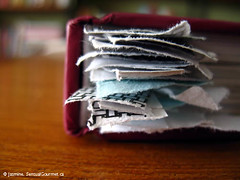
On My Shelves: Anita Stewart's Canada

Thanks to the kind people at Harper Collins Canada, I found a copy of Anita Stewart's Canada in my hot little hands.

Anita Stewart’s Canada
By Anita Stewart
Harper Collins Canada
336 pages; $34.95

I must admit when I heard that Anita Stewart (aka “Wonder Woman of Canadian Cuisine”) was undertaking what sounded to me like the equivalent of The Big Book of Canadian Cooking, I looked forward to what she’d present.

For those of you who don’t know Stewart, she’s a culinary icon up here. Passionate about Canadian food along with the people who grow, produce, cook and eat it, this culinary activist and “gastronomer” spent 30 years discovering and trying to define Canadian Cuisine. Her journey includes penning 14 cookbooks (including this one) and a regular gig on CBC Radio One’s Fresh Air. The founder of Cuisine Canada, an organisation for food professionals that promotes fine Canadian food and wine, while administering Canadian cookbook awards, she also sits on the jury of the World Food Media Awards.

Anita Stewart's Canada is part cookery book, part reference book encompassing bits of anthropology, botany, history and sociology, and part call to arms regarding local eating and food production, all punctuated with photographs taken by her or Robert Wigington.

Because of how the book is put together, I think the writing is of greater importance than in most other cookbooks. Stewart’s writing is easily divisible into three voices –the storyteller, the research historian and the food activist:

Stewart the storyteller includes some of the interesting people she’s met in her travels such as Diane Bernard who harvests seaweed, Roger Dufau who owned Toronto’s Le Petit Gourmet and Devini DeSilva, a research associate at the University of Saskatchewan. Stewart’s storytelling draws in the reader to how these people or their foods have added to Canadian eating.

Stewart the research historian can weave an interesting story such as the Three Sisters soup and its ingredients' roles in First Nations’ culture but she can mire the reader in dry facts and figures such as the nutritional benefits of oats. One of the more interesting facets of this book is how she tracks immigrant groups and their stories: sidebars on groups such as the Brazilians, Iranians, Jamaicans, Malaysians, Portuguese and Swiss in Canada help to provide readers a fuller picture of who it is that makes up this nation.

Stewart the food activist is earnest but quite honestly comes off as a bit preachy. Because of that I think it’s the least impressive and effective of the three—granted this could be because I am generally fatigued by the seemingly unending influx of food activist-warriors. Whether she’s telling us that the Atlantic Salmon Federation is “ringing alarm bells and mobilizing volunteers” or being “blown away” by a sac of potatoes endorsed by the World Wildlife Federation, I think there could be a more successful way of relaying this information to readers.

A reference book is really only of use if it has a good and thorough index. Unfortunately, this one doesn’t. A few weeks after reading it, I wanted to find a particular recipe, but could only remember its originating culture. Other recipes were listed, but not this one. After a couple of attempts with main ingredients, I finally found it. Add to this my trying to find a specific reference to Samuel de Champlain (who is mentioned throughout the book) and the L’ordre de bon temps, and I was more than frustrated when neither appeared in the index.

This book’s strengths lie in its cookery portion. Quite honestly: I like it. I think it identifies the many flavours and facets of Canadian cuisine and makes people think beyond the obvious.

The book isn’t divided into the traditional breakfast, lunch, supper, snacks, dessert and other. Nor is it really broken into headings such as breads, meats and drinks. Stewart has instead cleverly divided the collected 150-ish recipes into main ingredients, to certain extent mimicking their introductions to Canada’s dinner table. She starts with the Original Palate (what was here before European settlement), then discusses Maple Honey and Molasses, Corn Beans and Squash, Salmon, Fish and Shellfish, Meat and Poultry, then Gran, Potatoes, Dairy and Eggs, Fruit and Nuts and ends with what she calls The Contemporary Palate (partly the product of food science, partly the product of early 21st Century tastes and fashions).

Here she delves into samplings some of the many cultures which have found their ways to Canada. You can find recipes for Australian Pavlova, Finnish Coffee Bread, Greek Bougatsa, Japanese Gyozas, Malaysian Curry Chicken with Potatoes, Ismaili Peach and Black Pepper Potatoes, Russian-Jewish Halupches and Sri Lankan Coconut Roti along side Buckwheat-Buttermilk Crêpes, Butter Tarts, Classic Chicken and Dumplings, Crispy Potato Pancakes with Smoked Salmon and Maple Pouding Chomeur. I think because so many of the recipes come from home kitchens, they work, are uncomplicated and pretty easy to throw together. They are written with common sense in mind and (at least the ones I tried) came together really easily. Better yet, they were pretty tasty.

And which recipes did I try? I’ll be very honest and tell you that I have never flagged so many recipes in a cookbook sent to me to review--20ish, I think--they all just looked good. Somehow I narrowed them down to four—two I’d consider “traditionally Canadian” and two representing the cuisines that have added to our national menu.


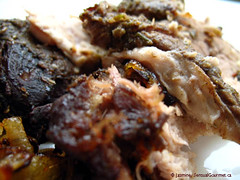
Jamaican Jerk Pork (p 126)
Whenever I go to a Caribbean restaurant, I gravitate towards the Jerk Pork. I know there are many other delicious things to have, but a good JP is usually why I’m there. I was very surprised at how easy it was to make. My only problem was of my own doing—the scotch bonnets I bought were pretty mild so the pork could have been zippier (but yes, my fingertips were a bit tingly). I’m going to try this again and either increase the number of peppers or try and find hotter peppers.


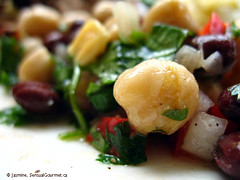
Karen’s Brazilian Black Bean and Chickpea Salad (p38)
In hot weather season I prefer to lunch on chickpea salads. This one is very easy and would do well at a summer barbecue. Its combination of coriander leaf, lime and apple cider give this salad was very pleasant.


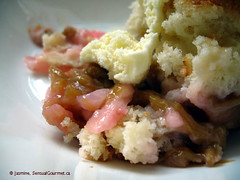
Nova Scotian Rhubarb Cobbler (p267)
Yup, this is where my rhubarby bounty went. This is one of those recipes that scream springtime in Canada and springtime in someone’s home kitchen. It’s very simple to put together and very satisfying coming out of the oven.


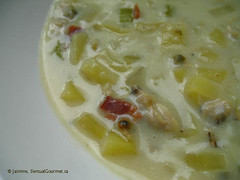
West Coast Clam Chowder (p90)
A good creamy clam chowder is always welcome in my soup bowl on cold nights. This chowder was so easy to put together and not too bad. I’ll probably make it on a regular basis once the temperatures dip.


Anita Stewart’s Canada is a pretty major undertaking. It traces the many histories of our land—social, cultural and ethnographic as well as botanical and agricultural—and synthesizes this information into a sampling of diverse dishes that donate to the definition of what food is in Canada.

So how does it rate?
Overall: 3.5/5


The breakdown:
Recipe Selection: 4/5
Writing: 2.5/5
Ease of use: 3.5/5
Yum factor: 3.5/5
Table-top test: Pretty much lies flat

Kitchen comfort-level: Novice-intermediate
Pro: It gets people thinking beyond maple syrup, salmon and poutine.
Con: Uneven writing and inadequate index make the prose difficult to get through and specific recipes can be difficult to find.


cheers!
jasmine


AddThis Social Bookmark Button

03 June 2008

Invitation: Mmm...Canada

"Tell me what you eat, and I will tell you what you are.”
- Brillat-Savarin, The Physiology of Taste

Long before Samuel De Champlain’s L’ordre de bon temps feasted in Port Royal, our First Nations’ peoples gathered and shared what they hunted and grew. Settlers arrived, and adapted their food traditions to the wild and cultivated bounties they found. Immigrants brought new crops and herds, techniques and ideas to Canada, furthering expanding our national palate.

New Canadians used their traditional meals as a connection to the home and family they left thousands of kilometres away. Eventually, as people from different cultures began living side by side, meals were shared and replicated in other kitchens. From kitchen to kitchen, table to table and plate to plate, foods were adapted and shared and adapted again to become an integral part of the Canadian mosaic.

I think it’s time to celebrate the foods that help to make Canada, well, Canada.

But which foods are they? Are they traditional and indigenous ingredients such as salmon, maple syrup, bison, Jerusalem artichokes and corn? What about what early European settlers brought and whose descendants helped to adapt and develop such as Red Fife wheat, cheeses, wines and spirits and Yukon Gold Potatoes? Or is it how subsequent immigrant waves tempt our palates with foods such as roti, gormeh-sabzi, kimchi and aloo gobi?

I think it’s all of the above and then some.

We have traditional European-inspired foods to cutting-edge fusion cuisine. We are brewers and vintners; we are cheese makers, chocolatiers and farmers.

Our restaurants boast everything from home-style dining to haute cuisine. Our bloggers write and photograph everything from regional foods to their own kitchen creations.

A few years ago, Jennifer of The Domestic Goddess celebrated the culinary diversity that is Canada through Taste Canada. She asked bloggers—Canadian, ex-pat Canadian and even a few wish-they-were-Canadians -- to share what Canada tastes like to them.

This year I’m continuing her quest, but asking you to share which savoury dishes or drinks tastes like Canada to you? Is it the first meal you had when you landed at Pearson? Can it be found in the handwritten notes your grandmother brought with her when she docked at Pier 21? What about the local food co-op that brings local, organically grown food to its members? Do the memories of the meat pies, smothered in gravy at your hometown's little ma and pa diner immediately spring to mind? Do you think Canada tastes like one of our many craft breweries or wineries? Or does a recipe or two from one of the dozens of Canadian foodbloggers let your imagination run away with you?

Any course, any reason, any season: it just needs to taste like Canada to you.

How to participate in Mmm…Canada, The Savoury Edition:


Write and upload your post between 23 and 28 June 2008. It can be in whatever form you wish: an essay, a series of photographs, a restaurant review, a recipe, an interview, a video.

Email me at cardamomaddict at gmail dot com (you know what to do) with the following information:

  • Your name
  • Your blog name and URL
  • Your post’s title and URL
  • One photo (if applicable), sized to 150 pixels wide, with your blog name as the filename
  • If you are a Canadian blogger, which province or territory you are in
  • If you are an expat Canadian blogger, which province or territory you are from and what country you are in now
  • If you want to be an honorary Canadian for this event (sorry, I’m not so powerful as to bestow that on you for your day-to-day affairs), what country you are in now
  • For those of you who want to use the Mmm…Canada, The Savoury Edition badge, you can find it here.

If you aren’t a blogger and would like to participate, please send me your contribution (along with the above info) and I will post your contribution onto my Kitchen Diaries site.

And in response to some questions I've received about the savoury side of things (to be updated as they come in):

  • You don't have to be Canadian to participate.
  • Savoury drinks would include things like beers, spirits, non-dessert wines...even beef tea. Dessert wines such as Ice Wine would be part of the SHF edition.
  • Entries can be in any language.
  • Entries must be new posts BUT if you really want to enter a recipe, dining or drinking experience, food aventure (etc) that you've previously blogged about, you can upload new content about it within the posting dates.
  • Please link back to the invitation post.

I’ll have my round-up posted for, when else, Canada Day (1 July 2008).

For those of you who think Canada’s pretty sweet, Jennifer is taking care of all Canadian-inspired sweet dishes in this month’s SHF: Mmm... Canada, the Sugar High Edition. And if you think Canada’s both sweet and savoury: yes, you can participate in both events.

Questions, concerns or anything else? Please send me an email.


cheers!
jasmine

Related Posts:

Mmm...Canada: A wee bit of inspiration

Round-up


AddThis Social Bookmark Button